
Fake News
The recent spread of fake news is important when marketing a brand, product or just someone’s image. The definition of fake news is fabricated news, it can be found on any kind of media, but has no basis in fact. In the recent presidential election, fake news was a favorite phrase Donald Trump used to deflect any bad stories about him, even though most had facts to back up claims. For media outlets, the ability to attract viewers to their websites is necessary to generate online advertising revenue. If publishing a story with false content attracts users, this benefits advertisers and improves ratings. Fake news is often created to influence views for political motives.

While some news sources are more reliable than others, everybody has their own opinion and choice on where they want to get their news from. There are seven types of fake news: parody, false connection, misleading content, false context, impostor content, manipulated content, and fabricated content. Below are some helpful ways to spot a fake news story.

It is so important to check if the content you share is coming from a credible source, before you share it to a wider audience. On social media, fake news can be spread around like wild fire if someone that has a huge following, like any of the Kardashian’s, shares something. Today, social media is where most people obtain their news from, rather than a newspaper or a news reporter.

Fake news can clog up news distributors, filling our timeline with meaningless information instead of informing people with worthy information. Facebook has taken a step to try and cut down on the “fake news” spreading on its platform, by flagging or reporting those posts as inaccurate. There are “bots” used by fake news publishers that make their articles appear more popular than they are. This makes it more likely for people to discover them. Bots are fake social media accounts that are programmed to automatically ‘like’ or retweet a particular message.
With the emergence of fake news, no one knows what is credible information and what is fake news. Celebrities that are considered role models, have to think twice before sharing content because of their power over their fan base.
Gossip magazines are NOT a credible source for news, I sometimes call them my “trash” magazines, I’ll grab one if I am about to board a plane but I would not go out of my way to buy one for fun.

Endorsements
Celebrity endorsements are also an important contributor to fake news. For Instagram influencers, they can promote a brand, like FitTea, knowing that their followers will go out and buy it. The influencer most likely did NOT actually use the product, just faked it to get payment and promote it to their audience.
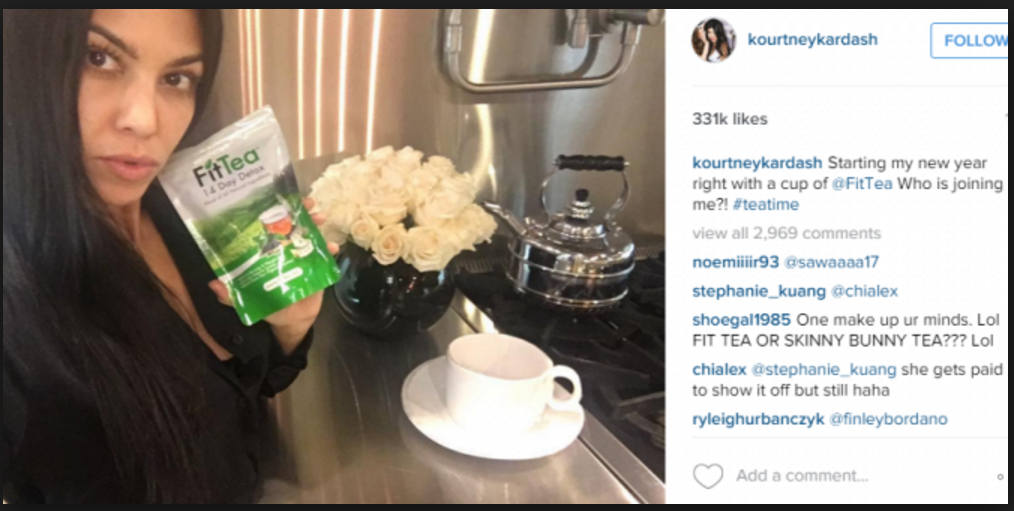

In conclusion, fake news is fabricated news, that can be spread on any social platform. The term became popular during the 2016 U.S Presidential Election with Donald Trump (just go view his Twitter). Celebrity endorsements can also be a form of fake news, if the product they are endorsing is not what it said it is.
Until Next Time
~RJ
 Hybrid Theory Thoughts Blog